What we're building
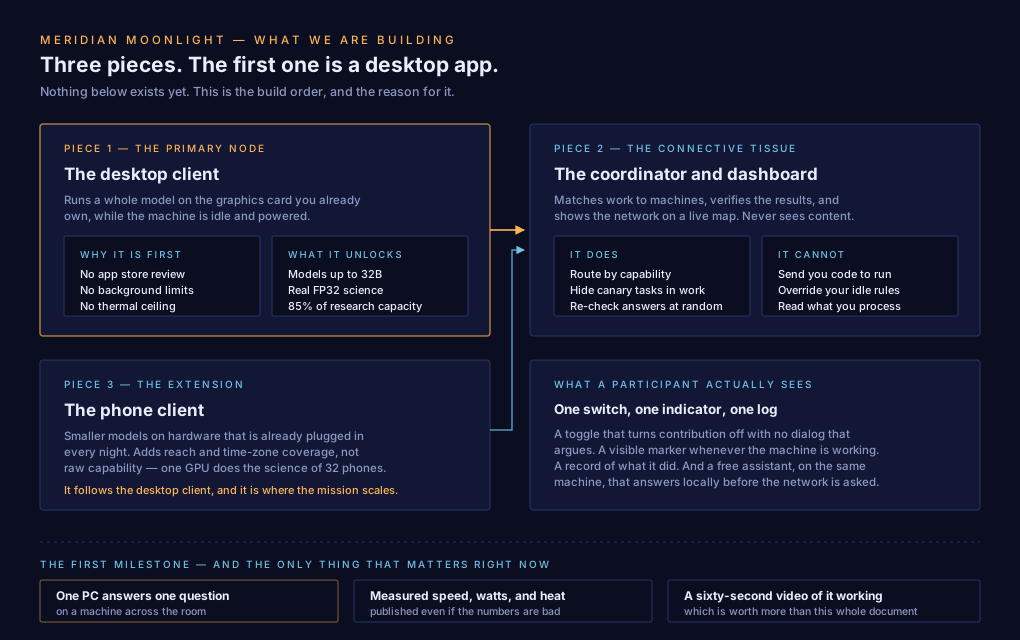
Three pieces. The first one is a desktop app.
None of it exists yet. This is the build order and the reason for it — and the only thing that matters right now is the bottom row.
Decentralized AI · No data center · No token
The most powerful computer in your house spends every night doing nothing. Meridian Moonlight turns idle PCs into a free AI network — real models, real science, on hardware you already own and electricity you're already paying for. Phones extend the reach. The PCs do the work.
Modelled, not measured — publishing the real curve from real nodes is Milestone 2.
What we're building
None of it exists yet. This is the build order and the reason for it — and the only thing that matters right now is the bottom row.
What it can do
Capacity and membership grow together, so every participant's share is about 274,000 words of AI output per day — roughly nine times what even a heavy user consumes, and five times that at the quietest hour of the global day.
That ratio is identical at a thousand devices and at a billion. There is no critical mass to reach, no chicken-and-egg problem that needs a token to solve, and no point at which this becomes useful — it starts useful.
The ~89% surplus is a research instrument.
The primary path
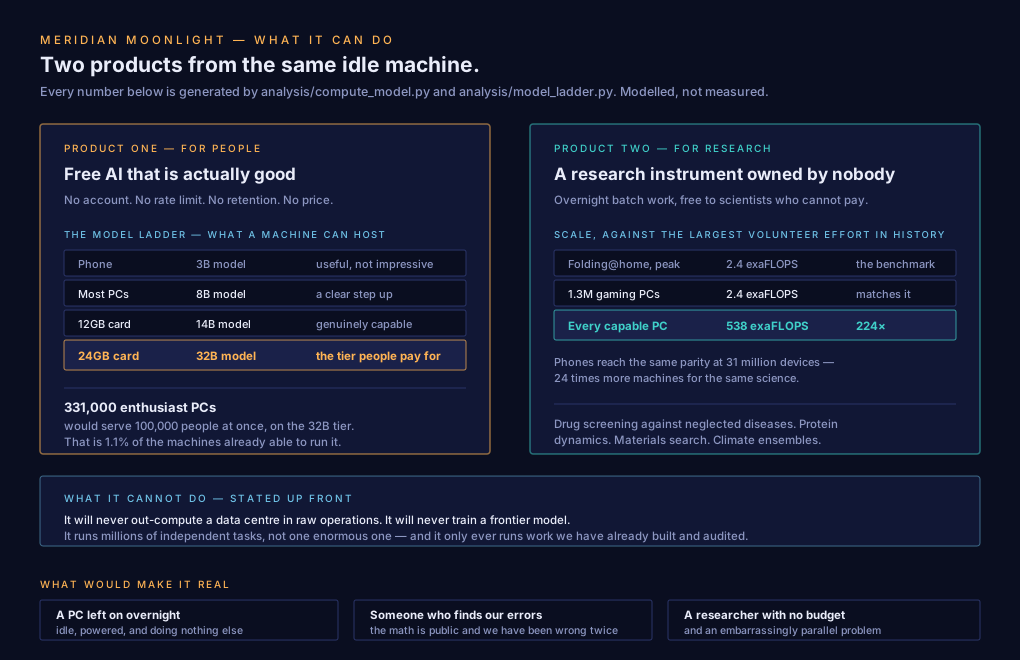
A gaming graphics card does the scientific work of about 32 phones, and it's the only hardware that can host a model big enough to compete with what people currently pay for. There are far fewer PCs, and people switch them off at night rather than plugging them in — and they still supply 85% of the network's science capacity.
So the desktop client is what we build first, and it's what the numbers on this page are about. The phone client follows, and it's where the mission scales — a billion devices already plugged in every night, reaching people who don't own a PC at all.
Primary · the engine
Extension · the reach
One detail that cuts against our own framing, because it should be said: a CPU-only desktop (0.20 TFLOPS) is worse for science than a phone (0.30). The advantage is entirely the graphics card — an office PC without one adds a machine and almost no capability. "PCs first" really means "graphics cards first".
How many people could be talking to a capable model at once — and at what quality. The science comes out of what's left over.
—
Who you recruit matters more than how many. The slider enrols typical PCs, and only about 3.3% of those have a card big enough for the 32B model. Recruiting enthusiasts directly is roughly 30× more efficient for the flagship tier: 331,000 machines with 24GB cards would serve 100,000 conversations at 32B — the same as enrolling about 10 million PCs at random.
Assumes 26 words/sec sustained per PC and 12.3 per phone, 19.6% and 25.7% mean availability, 15 words/sec per active conversation, and 30,000 words a day for a heavy user. 3.3% of PCs can host a 32B model fast enough to hold a conversation. Every constant is named in compute_model.py and model_ladder.py.
How it works
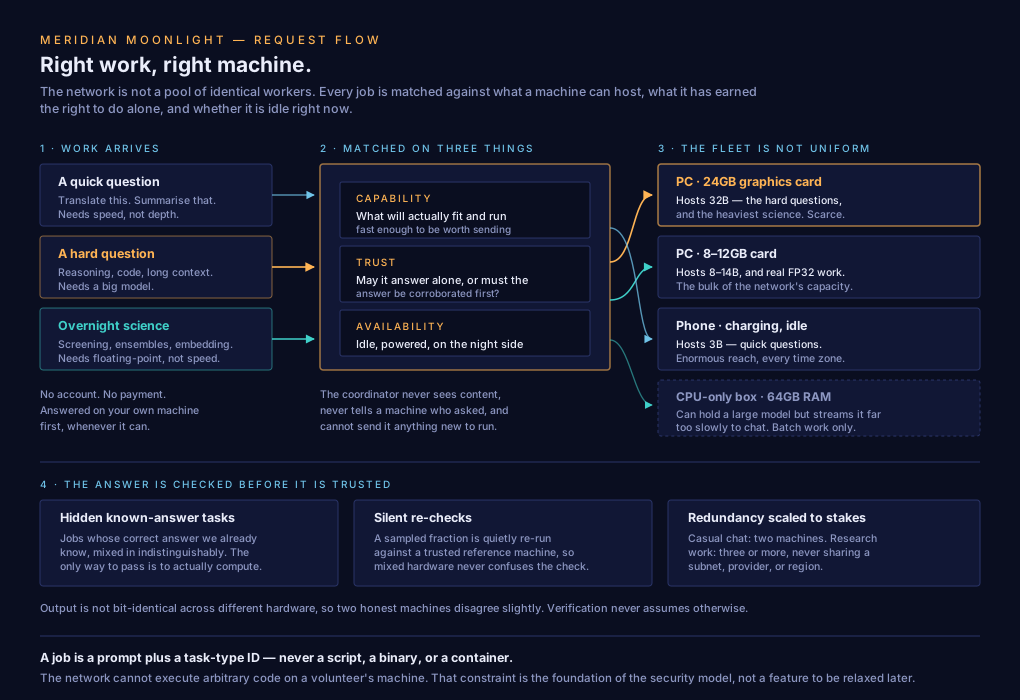
Every machine runs an entire model locally — up to 32B on a 24GB graphics card. Nothing is split across the internet, so there's no lag from shuttling data between machines, and your own prompts are answered on your own hardware before the network is involved.
On a PC: powered, on an unmetered connection, and not in use. On a phone: charging, Wi-Fi, screen off, above 80%. Gated to conditions where you'd never notice it, and one switch turns it off with no dialog that argues and no retention flow.
Demand peaks during the working day; supply peaks overnight. Since night circles the planet continuously, the network is always fed by the hemisphere that's asleep — and never drops below about 14% of the fleet.
Security
A job is a prompt plus a task name — never a script, a program, or a container. On phones and PCs alike. That removes crypto mining, password cracking, malware, and using your connection as a proxy — not as a rule we promise to enforce, but because there is no way to run them.
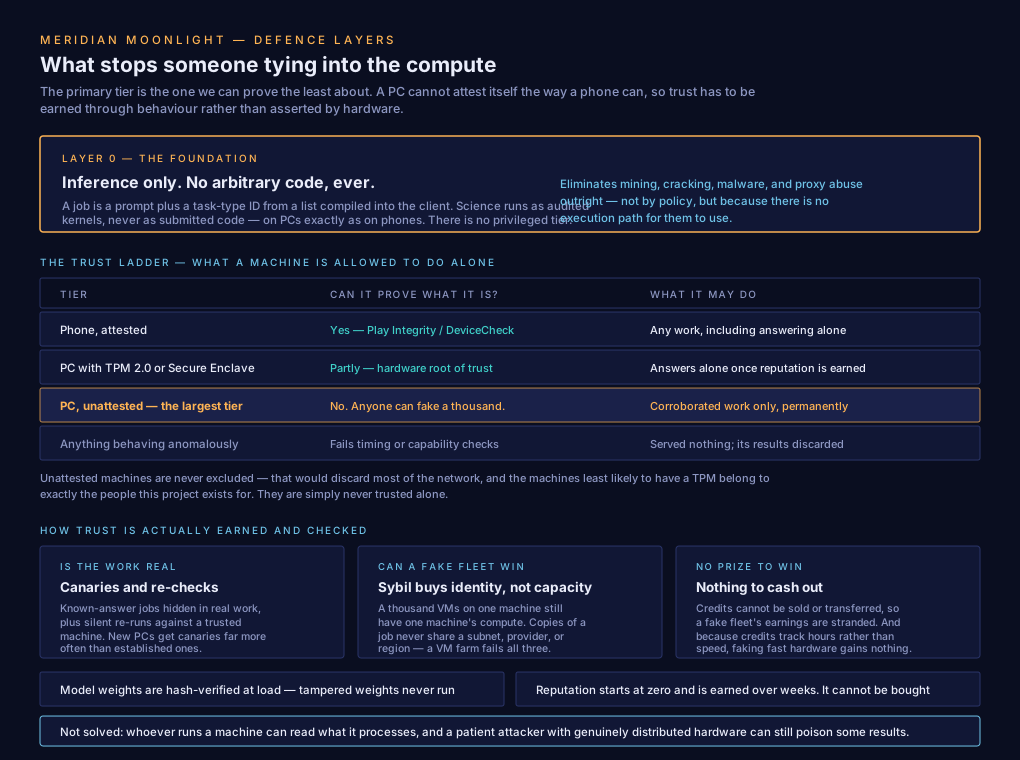
Competing networks run general-purpose runtimes to be flexible. That flexibility is exactly the attack surface. We trade capability for safety here, permanently.
Jobs whose correct answer we already know, mixed in indistinguishably. You can't tell one from real work, so the only way to pass is to actually compute. Plus silent spot re-checks against a trusted machine.
Credits can't be sold or transferred, so a fake fleet's earnings are stranded. Almost every attack on networks like this is financially motivated. Remove the money, remove the motive.
What this does not solve
The compute economy
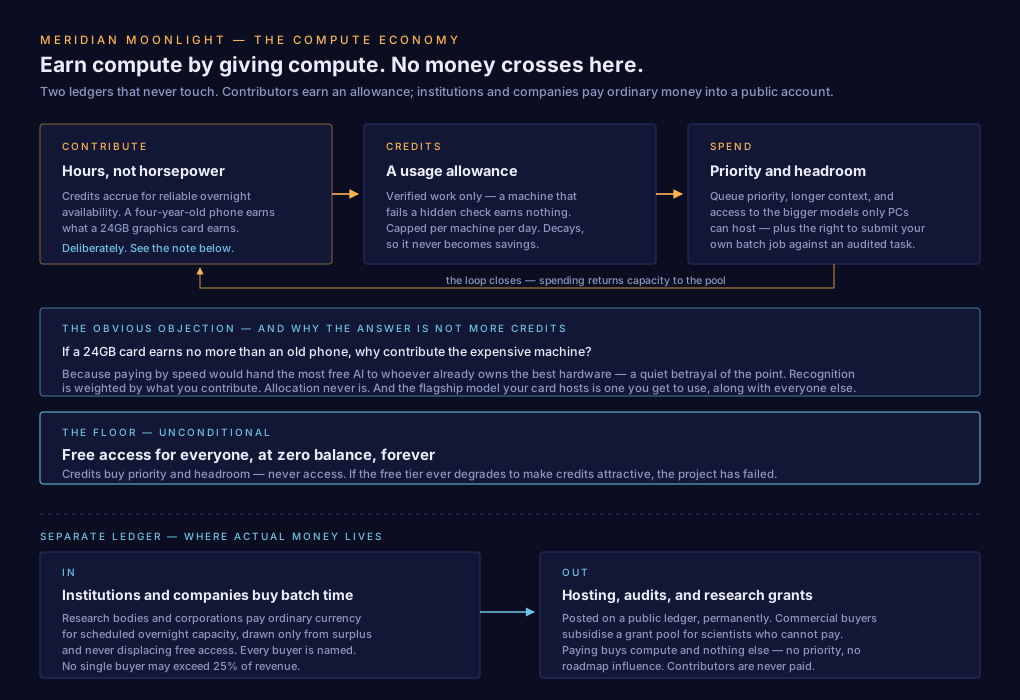
Credits accrue for reliable overnight availability. A four-year-old phone earns the same as a new flagship — because paying for speed would hand the most free AI to the people who need it least.
Verified work only. Capped per device per day. Decays over months so it never becomes savings. Can't be bought, sold, transferred, or cashed out — and never a vote.
Queue priority, larger models, longer context — and the right to submit your own batch job. That last one is the real economy: a researcher with no budget earns compute instead of buying it.
Credits buy priority and headroom — never access. If the free tier ever degrades to make credits attractive, the project has failed.
Institutions and companies buy scheduled overnight batch capacity in ordinary currency, drawn only from surplus. That revenue covers hosting, audits, developer time, and a research grant pool that gives free capacity to scientists who can't pay. Nine rules keep it honest:
Why not split that money among contributors? We costed it: a phone earns about $1.32 a year and burns $1.58 of its owner's electricity to do it. In most of the world you'd be paying us to participate.
Honest limits
Every project in this space leads with what it can do. Here's what physics forbids, stated up front — because a plan you can't poke holes in isn't a plan.
Two of this project's own claims have been retracted, and they're listed here rather than quietly deleted. If the numbers above are worth anything, it's because of how the ones below were handled.
| Claim | Previously | Corrected |
|---|---|---|
| Adoption needed to pass the largest data center | 1.4% — 30M phones | Not reachable at any adoption level |
| Cheating caught by comparing machines | Deterministic, so exact match works | Only within identical hardware — canaries and re-checks instead |
| Phones that can run a small model, today | 2.2 billion | 1.2 billion (2.2B is a ~2030 figure) |
| Devices available overnight | 95% | 60% — charging and Wi-Fi and undisturbed |
| Availability floor | ~33% of the fleet | 14.1% |
The first was a bad number: running an AI model is limited by memory bandwidth, not processing power, so a chip advertising 45 trillion operations per second sustains about 0.098. The second was worse — a wrong mechanism, which would have accused honest volunteers of cheating.
Every figure on this site is generated by one script you can run yourself. Find another error and we'll publish that too.
Open questions
Listed because pretending they're settled would be the actual problem.
The promise
Most decentralized compute networks pay contributors in cryptocurrency and sell the compute back to developers. Moonlight isn't a marketplace. It's a public utility: free to use, free to join, and open source end to end. Whatever eventually pays the hosting bill, it will never be your access, your attention, or your data.
If you ever see a Meridian Moonlight token for sale anywhere, it's a scam — and we'd appreciate the heads-up.
Roadmap
A phone and a desktop each run a model overnight. Three deliverables matter more than the code: measured speed, watts and heat; where identical hardware actually produces identical answers; and a sixty-second video of it working.
Work routes between volunteers' machines, with known-answer canaries, spot re-checks, reputation scoring, and a live map of who's online.
Region-aware routing, the measured 24-hour availability curve published against the modelled one, and the first real overnight science job.
Specification v1.0 so anyone can build a compatible node — or run a competing coordinator without asking us. Plus governance, a legal structure, an external security audit, and the first research partner. If this spec doesn't ship, our "centralized for now" defence was a rationalisation.
Full peer-to-peer discovery and a standing institutional research programme. A network no single party can switch off.
Join
No sign-up form, no mailing list, no pledge to make. Send an email and a person replies. Tell us what machine you have and what you'd like to do — that's genuinely the information we need most right now.
Opens your email app with a short template. Or write to hello@meridianmoonlight.com directly. Nothing is stored on this site — it has no database and no tracking.
Every figure is generated by one script with named assumptions and stated confidence. We've flagged our own weakest inputs and been wrong twice already — find a third.
Buildersllama.cpp, a contribution gate, and a Node coordinator. The desktop client has no app store in its way — it's the fastest route to something that actually runs.
ResearchersEmbarrassingly parallel problem and no budget? That's what the surplus is for. Tell us its shape now — it changes what we build first.